
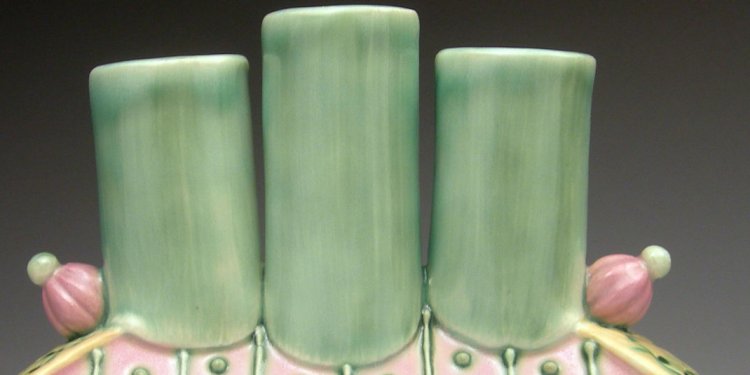
Sandi Pierantozzi
By Gail Molnar Pfeifer
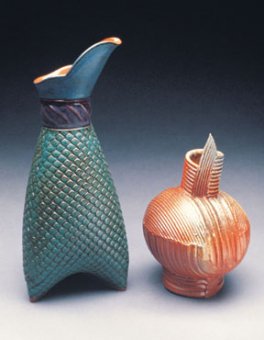
Carafe and Bottle by Sandi Pierantozzi and Neil Patterson
Taking a class with Sandi Pierantozzi and Neil Patterson is like having good friends who are master potters teach you everything they know. On a schedule that might include several workshops a year, how do they convey this kind of personal touch? Although they make it look easy, it takes planning, skill, and a generosity of spirit that inspires creativity in their students.
Their teaching helps participants take ideas from demonstrations, explore and expand on those ideas, and make them into personally expressive pottery. "We don't want the whole class making 'Sandi and Neil pots, ' so although we show the techniques specific to our own work, we encourage experimentation with an emphasis on the process of making the pots, rather than on the product being made, " says Sandi. In her opinion, this lends an excitement to the experience that would otherwise be absent for people. "We want students to take what they learnwe have no secrets and make it their own, " she says.
 Although Pierantozzi and Patterson use templates for designing handles and spouts, for example, they don't bring templates for students to trace. Instead, they help students understand the structure of form, the relationship between all of the parts of the pot, and their effect on composition. Students can then decide on the best spout or handle for their own work. Once that decision is made, Sandi and Neil show the students how to create a template specifically designed for the work they've created.
Workshops are structured to cover a variety of thrown, handbuilt and altered forms: cups, bowls, pitchers, vases, oval shapes, covered jars, and teapots. Sandi usually demonstrates each form by handbuilding with slabs, and Neil demonstrates how to throw the same form on the wheel.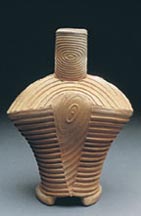 This tag-team method of teaching provides students two different ways of manipulating clay into a desired shape, and opens up new avenues of thought. "I am more inclined to throw than to handbuild, " writes Janet Belden about her experience at an August 1997 workshop at Peter's Valley, Layton, NJ, "but this workshop made me more aware of the possibilities of working with clay."
Sandi and Neil say this awareness emerges easily at arts centers like Peter's Valley, Penland (North Carolina) and Anderson Ranch (Snowmass, Colorado) for several reasons; the atmosphere is non-academic, community-oriented and informal. An arts center location lends itself to hands-on work in a way that inspires sharing rather than criticism.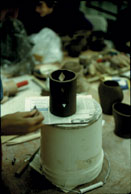 Carrying on this hands-on philosophy, Sandi and Neil encourage students to sketch, rather than videotape, during the demonstrations. Sketching is more personal, in their opinion, and so encourages a unique interpretation of what is being taught.
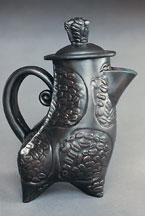
Funky Bean Coffee Pot by Sandi Pierantozzi
Bottle by Neil Patterson
A technique they used at the Peter's Valley workshop, named "parts and darts, " is a good example of Sandi and Neil's teaching approach. They start the demonstration with a basic cylinder, either handbuilt or thrown, then cut out sections to make darts, and shape the cylinder into a new form.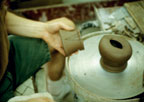 The altered sections, or parts, are then stacked and re-stacked to develop more forms. (See photos) "It never fails, " says Sandi, "that each student creates totally different, very personal forms. This is what makes the workshop successful for us."
Textures are an important part of both Sandi and Neil's signature work, so portions of their workshops address how to produce textures in clay. Neil throws his pots, then uses various wooden tools that he has made over the years, to texture them. Sandi rolls a slab, then presses found objects, clay stamps, rollers, or bisque molds of textured surfaces into the clay. She then forms a cylinder and makes darts as necessary to shape the final product. She either makes feet for the piece or cuts the bottoms to fit whatever form the pot eventually takes.
Being well-prepared and letting students know what would happen in advance was appreciated by the workshop participants. "While there was ample flexibility for plans to change, I didn't feel as if the sands were shifting beneath my feet, " writes Marla Bollack, another participant at the August workshop.
Share this article
Related Posts

Latest Posts


